88% of Top Home Service Businesses Use AI. Here's What They're Doing That You're Not.
There's a number I can't stop thinking about.
The Jobber 2026 Home Service Trends Report surveyed thousands of home service business owners — HVAC techs, plumbers, roofers, landscapers, electricians — and found something that should make every contractor in America pay attention.
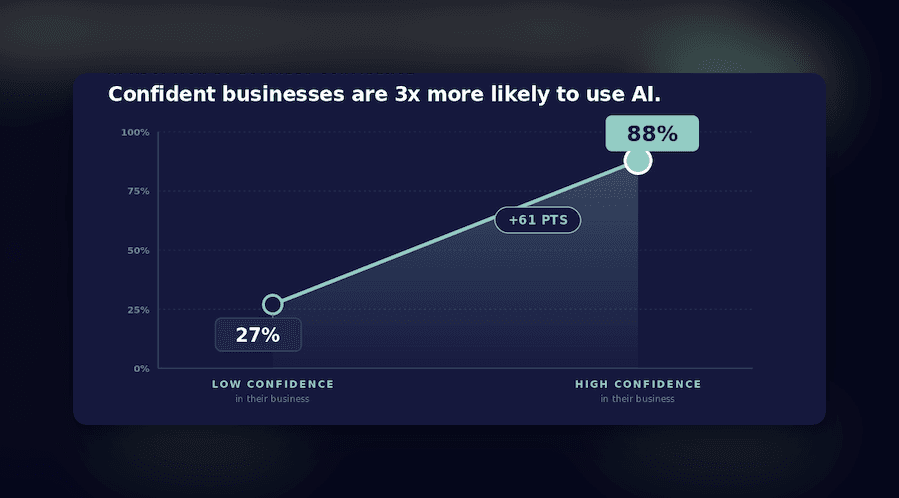
88% of home service businesses with high confidence in their future are using AI. Among businesses with low confidence? Only 27%.
That's not a small gap. That's a canyon. And it's not about who has the most trucks or the biggest ad budget. It's about who figured out that the tools have changed — and changed how they work because of it.
THE GAP ISN'T ABOUT TECHNOLOGY - IT'S ABOUT WHAT YOU DO WITH TUESDAY
Let me be clear about something: the 88% aren't building robots. They're not hiring data scientists. Most of them couldn't write a line of code if you paid them.
What they're doing is using AI for the boring, expensive, time-consuming stuff that eats their week alive. According to the Jobber data, here's where home service businesses are actually using AI right now:
Quoting and estimating — 54%. Instead of spending 45 minutes building a custom quote after every site visit, AI tools pull from your job history, local material costs, and square footage to generate an accurate estimate in minutes. You review it, adjust if needed, and send it while you're still in the customer's driveway.
Invoicing and payments — 52%. Auto-generated invoices after job completion. Payment links texted to the customer before you've loaded your van. No more chasing checks two weeks later.
Business writing and communication — 51%. Follow-up emails, review requests, appointment confirmations, seasonal maintenance reminders — all drafted and sent automatically. The customer thinks you have an office team. You have a laptop and a $50/month subscription.
This isn't futuristic. This is what a plumber in Phoenix is doing right now while his competitor is still handwriting invoices on carbon paper.
WHAT THE TOP CONTRACTORS ACTUALLY USE
Real tools, real prices
I talk to small business owners every week, and the number one question I get is: "Okay, but what tools specifically?" Fair enough. Let me be specific.
ServiceTitan is the big dog in home services — dispatching, scheduling, invoicing, marketing, all in one. It's powerful. It's also priced for larger operations ($200+ per technician/month). If you're running 10+ trucks, it's worth a serious look.
Housecall Pro and Jobber are where most small-to-mid contractors land. Both offer AI-assisted scheduling, quoting, invoicing, and customer communication in the $50–$150/month range. They're built for the two-to-fifteen-person company that doesn't want to hire an office manager yet.
For AI-powered phone answering — which I wrote about this week too — tools like Goodcall and Smith.ai are running $200–$500/month and capturing leads that would've gone to voicemail.
For workflow automation beyond these platforms, n8n is the tool I keep coming back to. It connects your CRM, your calendar, your email, your invoicing — and it runs workflows automatically without you touching anything.
The point isn't that you need all of these. The point is that the contractors in that 88% picked one or two, learned them, and let the tools handle the work they used to do manually.
THE REAL COST OF NOT ADOPTING
This is a compounding problem
Here's what worries me about the 27% on the other side of that gap.
It's not that they'll go out of business tomorrow. It's that the gap compounds. Every month that a competitor sends faster quotes, answers more calls, and follows up automatically, they're pulling ahead — not just in revenue, but in reputation, reviews, and referrals.
The Jobber report found that 75% of home service business owners expect revenue growth in 2026. But the ones who are confident about it — the 88% — aren't just hoping. They've built systems that make growth manageable. They can take on more jobs without hiring more people because the administrative work that used to eat half their day is handled.
I think about this through the lens of my friend Nelson's frame shop. When we rebuilt Cardinal Frames from scratch — new CRM, new website, new processes — the business didn't just get more efficient. Nelson got his time back. He stopped being the owner, the salesperson, the accountant, and the shipping department all at once. He started being the owner again.
That's what AI adoption looks like in practice for a home service business. It's not about replacing people. It's about giving the owner back the three or four hours a day they're currently spending on things a computer can do better and faster.
WHERE TO START IF YOU'RE IN THE 27%
Honest advice from someone who spends hours reviewing tools
If you're reading this and thinking "I know I'm behind," here's the good news: catching up doesn't require a massive investment. It requires picking one thing and doing it this week.
Start with the thing that costs you the most time. Is it quoting? Invoicing? Answering the phone? Customer follow-ups? Pick the biggest time drain and find a tool that handles it.
Try one tool for 30 days. Most of these platforms offer free trials. Don't sign up for three at once. Pick one. Learn it. Measure what changes.
Automate after the process works. I'll say this every time because it's the most important thing I know about technology: you can't automate a broken process. Get the workflow right first. Then let the tool take over.
The difference between a three-person crew that's grinding and a three-person crew that's growing isn't more trucks. It's not more ads. It's the systems they've built behind the scenes.
If you're a home service business owner wondering where to start, that's exactly the kind of conversation I have every week.